

The World of Roots

Village info and maps for Rudania, Inariko, and Vhintl.

Current Year: 1005 AB

Village Info and Maps

The Villages

Members can mark where their OCs live on the village maps through the ROTW Map on the Tinglebot dashboard.

Villages can be upgraded through community donations in Discord — use /village donate in each village's town hall. See the Village Upgrades guide for the full mechanic.

Changing a Character's Village

What if you'd like to make your character move from their original village to another one, for RP reasons, or just for fun? You can use the command /character changevillage in #community-board! See the Travel guide for /travel and visiting other villages.

Example
/character changevillage charactername: [Your Character] newvillage: [New Village Name]

Quick Steps

  • Type /character changevillage in #community-board
  • Select your character from the charactername dropdown
  • Choose the new village from the newvillage dropdown
  • Confirm the change

Requirements

  • 500 tokens
  • At least 30 days since your last village change

Important Notes

  • You can only change villages once per month
  • You cannot change to the same village you already have
  • Some jobs are village-exclusive — you may need to change your job first if it conflicts with the new village

Tips

  • Both fields use autocomplete — start typing to see options
  • The command will show an error if you don't meet the requirements
  • Your new village change date will be shown after a successful change

Current Year: 1005 AB

Before 999 AB

Traveling from one village to another was too dangerous. Paths and roads existed, but were rarely taken and only in the most extreme cases. If anyone dared to take them their chances of survival were slim to none.

All races known at the time resided in the three villages. While some chose to live directly inside of the villages, it wasn't unheard of for people to live on their outskirts. But this was a dangerous choice as monsters were more likely to attack.

In rare cases, some people left their home village for another — but the journey was incredibly dangerous and not without consequence. (Roots only allows this if the character has a history that seems plausible, and if the mods approve of it. But in general all characters need to be born, and raised in ONE village without traveling.)

Year 999 AB

For eight months travel was possible between all three villages, as the villagers had worked together to push back the Blight enough to fully uncover the roads for the first time in nearly a millennium. The roads were still dangerous and travel parties were far more likely to make it to their destination unscathed versus an individual traveling alone, but many sprung on the opportunity to reconnect with their long-lost neighbors.

During this window of time, trade and travel between the villages exploded, and since then with the roads re-closing after the Blight Bloom many individuals have been displaced from their original homes and forced to take up residence in the villages they were stranded in.

Travel between adjacent villages when the roads are open takes two days and one night's time on foot while following the roads — longer if detours and stops are taken or dangerous environments and monsters are encountered. See the Travel guide for the /travel command and current rules.

Rudania to Vhintl or vice versa increases that time with double the distance and a village stop in Inariko in between, making it five days travel with two nights spent in the dangerous wilds.

Mounted travel time is cut in half.

Village Safety

Within the pink circle is what is considered safe for villagers. Once you leave the safety of the pink circle, that is considered the outskirts of the village. No one can safely live outside of the cyan circle and survive in these perilous times.

OC home locations are marked on each village map through the ROTW Map on the Tinglebot dashboard.

The Villages

Rudania, Inariko, and Vhintl — the three settlements where life continues against the Blight.

Rudania — Akkala Valley

Rudania

Akkala Valley

A fiery spirit carved into volcanic stone

Goron & Gerudo

About the Village

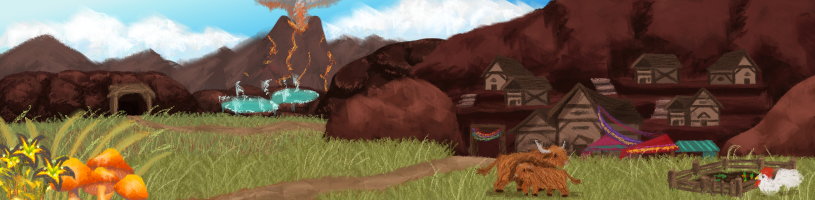
Rudania is a multilevel village located in Akkala Valley, in the shade of a tall spire of rock which overlooks Lake Akkala. The buildings of the village are partially carved into the curved cliffs of rock which wrap around the valley, moving from the valley floor upward via hewn stone pathways and staircases. The village is constructed of stone, cob and adobe, and is typically decorated in colorful chalk and mud paint murals as well as statuary of Goron and Gerudo design, in metal and stone alike.

On clear days with no risk of volcanic cinderstorms, bright tapestries and woven cloth garlands are often strung up to wave in the wind. During Rudania's frequent bright and boisterous festivals the village explodes in an abundance of these decorations.

Rudania's culture reflects the village's primarily Goron and Gerudo residents, and is a fiery spirit that celebrates almost every aspect of life.

Climate

Rudania lies between an active volcano and a large lake, and experiences a wide range of weather as a result — from a typically balmy, pleasant climate even in winter, down to the days when the volcano is acting up and sending hot, dry air gusting over the valley. Every now and then the village also experiences the phenomena known as cinder storms. This has earned the village the reputation of "always being on fire."

Key Locations

  • Farmlands

    South of Rudania village, large swaths of volcanic-rich land have been devoted to farming of both livestock and crops. The farmlands take up half of the valley and are encircled by Rudania's stone walls which guard the eastern and western outlets in and out of the valley, ensuring that the farmlands remain safe from most large monsters day and night.

  • Eldin Mines

    Located south of the village, carved into the cliff face and tunneling deep below the western plateau of Akkala Valley, the mines are one of the newer additions to Rudania's development. They have been instrumental in providing the village with metals, earth and ore for the village's various needs.

  • Volga Forge

    A massive workshop which houses multiple smiths and craftsmen in Rudania, and far surpasses every other metalworking outlet in all of known Hyrule. Rudania's forge boasts the hottest furnace available between all three villages and as a result produces some of the finest metals any of the villages have ever seen. All three villages owe many of their high-grade weapons to Rudania's forge.

  • Hot Springs

    To the West, beyond the safety of the village on the far side of Cephla Lake lies a collection of natural hot springs, ponds heated to a comfortable simmer by underground volcanic activity. Despite the danger of being so far beyond the village borders, many Rudanians risk the trip to bask in the hot springs, which are said to have healing properties.

Inariko — Lanayru Promenade

Inariko

Lanayru Promenade

Ancient wisdom along the canyon river

Zora & Sheikah

About the Village

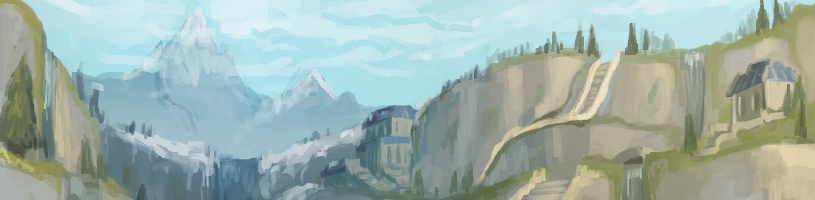
Spanning the old Lanaryu Promenade, Inariko is a village built on top of ancient construction which rims the waterway, with a mix of old and new in primarily Zora and Sheikah style. The village is constructed vertically, stone houses at the lowest levels on and below the waterline typically belonging to Zora residents, and further up stone makes way for wood construction with architecture becoming more distinctly Sheikah in design.

Many residents' homes at the waterline are designed to allow direct access into the water. Inariko is a fishing village, taking advantage of the length of otherwise underground river which breaches the surface within the canyon of the old Promenade. Winding staircases, pathways and climbs link the village up and down its sheer faces, and multiple bridges of varying sizes span the river to join every side of the village together, including bridges large enough to have multiple buildings on them.

Inariko carries a formal air with its combined Zora and Sheikah aesthetic style. The Zora's expert underwater architecture and stonework skills support the village at its foundations, while the 'human' residents make their homes further up the canyon walls and tend to small plots of crops along the topmost edges of the canyon.

Climate

The land surrounding Inariko is hilly and dotted with forests, rising in elevation toward Mount Lanayru east of the village. The snowcapped mountain sends cold winds year-round down into the village, resulting in a typically cool climate. Inariko experiences long winters, heavy snowfall and even blizzards.

Key Locations

  • Dragon's Gate

    The large stone gate at the eastern end of the Promenade which marks the edge of Inariko village, and lets out onto a small flat and forested field which leads into the frigid foothills of Mount Lanayru. The gate has a perfect view of the looming mountain, which is the home of the Dragon of Wisdom, Sanskar. Pilgrimages to Mount Lanayru begin with the first step passing through the Dragon's Gate.

  • Nayru Statue Waterwheel

    A large waterwheel spins in the center of the village's river. It creates a perpetual slow whirlpool and provides hydro power for milling and for the Research Lab's strange experiments. In the stationary center of this spinning waterwheel is a large and ancient statue dedicated to the goddess Nayru, battered with time but still much-loved and cared for by the village residents. The statue is often painted with pigments made from ground luminous plants such as Blue Nightshade, which still continue to glow on the statue after sunset in a soft shade of blue. The Nayru statue is damaged and missing its outstretched arms, so whatever object the Goddess of Wisdom may have been holding before is no longer known.

  • Inariko Library

    The most extensive collection of knowledge existing in the known world, the library houses books, documents, historical records and some artifacts, their contents ranging from entertainment and fiction to informational records and elder knowledge committed to text for posterity. Entry into the library and loaning of materials is carefully and meticulously monitored in order to maintain this precious wealth of knowledge, and scholars are known to devote years of their lives to hand-writing duplicates of documents they deem important. The library is set deep into the ages old stonework of the ancient promenade, the front entrance a decorative facing carved with the image of Inariko's Dragon of Wisdom, Sanskar. Inside, stone walkways and staircases provide access to each of its three levels, various nooks around the place providing semi-private spaces within which visitors may read and study in peace. While it is known that there are doors potentially leading even deeper into the cliffside, they have been sealed and inaccessible for longer than anyone is alive to remember.

Vhintl — Southern Faron

Vhintl

Southern Faron

A canopy village above the wilds

Korok & Rito

About the Village

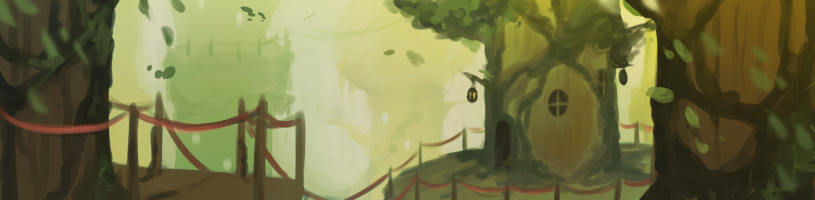
In the subtropical forest of the southern Faron region, the village of treehouses known as Vhintl hides high in the treetops within a heavily forested basin. The majority of the village is located high above the ground and interlinked by a complex web of rope bridges and ziplines, as well as pulleys, rope ladders, and manual elevators linking the upper village to the forest floor.

Vhintl has a large population of Koroks and Rito, and these races thrive in the elevated treehouse village. These two unique race's housing needs and flight capabilities have come together to develop a unique open-plan architecture style which relies on materials harvested straight from the forest — wood, woven leaves and canvas, thatching and straw.

While the ground is generally too dangerous to inhabit, a few hardier folk have been bold enough to make their homes and businesses on the forest floor in more defensible areas and constructions. Some limited ground for growing food exists below, but most is done via potted rows on the wood pathways and platforms above. Luckily this limitation doesn't set them back much, as much of what's needed to keep the village fed can usually be foraged from the natural abundance of the surrounding forest.

Climate

The thick forests and jungle of Faron keep Vhintl's temperatures consistent through each season, ranging from warm and muggy in the summer to cold and snowy in the winter. The mix of plantlife keeps the area green year round, even under heavy snow. The area experiences heavy rainfall and an uncanny number of lightning storms, and thick mists and fog banks are a frequent occurrence in the area.

Key Locations

  • Skulltula Pass

    Vhintl is well known for its large spiders. South of Floria River in a grove which used to be called Pagos Woods, monster spiders known as Skulltula have made lairs easily identified by the thick spider silk webbing which spreads across the dense trees and over the ground, catching prey for the hungry monsters. This area of forest was once the only western path out of the Faron region, but ever since the Skulltulas became the woods' new namesake, Skulltula Pass has been impassible. With the passage of time and increased danger from blight, what lies beyond this point is now a mystery.

  • Spiderbite Ruins

    Recently uncovered thanks to a mudslide, a deep well of ancient construction plunges into the earth in the Skulltula Pass wood, and upon further investigation by a few brave souls the well was discovered to be a large inverted tower, extending many floors deep below ground. Only the first floor has been explored thus far, and proven to be the extremely dangerous home of monstrous arthropods and Skulltulas the size of which has never been encountered before in known history. Some of those who entered the place dubbed it "Spiderbite Ruins" after their experiences exploring it, and the name has since caught on to become its known title.

  • Deku Tree Sprout

    When the Great Deku Tree of the northerly Korok Forest died, a great seed was left behind. Foras, the Dragon of Courage, gathered the seed and transported it safely to Vhintl, where it was cared for among the many smaller Korok seeds which The Deku Tree had blessed to give life to the next generation of forest children in his absence. Since then the Deku Tree Seed has been planted and sprouted somewhere in the forests of Faron, but its exact location is not known.

  • House of Masks

    Safely backed against a cliffside along the South-West end of the valley, the building is a makeshift museum for various artifacts.

  • Dragon Head Cavern

    Just north of Vhintl's outskirts, the Dracozu River opens its mouth into an open field with a small path leading up toward a massive stone dragon head carved by an unknown people in time immemorial. The dragon head is the opening to a cave which tunnels through the hillside, revealing a secluded spring at the back. Despite the scenic appearance of the spring and the awe-inspiring giant stone dragon head, Blight has contaminated the area and spoiled the view; thus most villagers avoid wandering this way.